

Part Two - The Hardest Part
Starting a book is a challenge, but finishing/getting it out is harder

In Part One, I wrote about the process of beginning my first memoir, finishing a draft, revising a time or two, then finding an agent. I thought the end was in sight.
Then the hard part started.
My agent and I worked out a plan. I would hire an editor to help me shape the arc of my manuscript into something hopefully saleable. Also, eventually I would craft a book proposal with a sample chapter and chapter outline that broke down the whole of the book into a smaller number of pages. Finesse a bio, bigging myself up. Gather comp titles (this probably changed as the year or two to finish the proposal went by: goodbye Patti Smith, Kim Gordon and Chrissie Hynde, hello Carrie Brownstein and Viv Albertine. The publishing world moves at a glacial pace but the shelf life of new books is relatively short.)
Looking back, I think I worked with…four different editors. First was the agent’s assistant. She was brilliant and zero’ed in on the New York story being the thing to focus on. I had to leave most of my childhood in Pittsburgh on the cutting room floor.
The next editor—the first I actually hired and paid for out of my own pocket— asked me important questions to narrow the focus to…music. In retrospect that seems obvious, but when you’re writing about your life, it’s easy to go down many cul de sacs about all the things and people you love and are interested in: French fashion magazines of the 60s and 70s; New York bars and clubs of the 70s, 80s and 90s. The corporate hierarchy of Sony Music and street layout of Nashville—the whole road map of the US and barbq places located along those interstates and highways, to be honest. Those are just a few things I had to pare back. It was months of work. There were many times I thought “this is too hard.” I’d already written the book and revised it. Now I was rewriting it in a condensed form.
When the proposal went out to major publishers, the feedback was positive. Editors liked my writing. New York in the late 20th century was a nice niche. We felt like we were on the right track. But there were no solid yeses. I wasn’t well-known enough/didn’t have enough of a following to attract a big publisher, and maybe the story arc wasn’t all the way there enough yet for the book to stand on its own merits.
I kept busy playing gigs, doing some touring, working in the bookstore/bar, writing songs and recording my first solo album in over ten years, The Old Guys. One publisher seemed seriously interested at last, but they wanted more focus on New York City and less on…me.
The twentieth anniversary of my first solo album Diary Of A Mod Housewife was approaching, and I decided to do a vinyl pressing. There was a learning curve with that but it kept me busy while I waited for answers from the next round of submissions to smaller publishers (mostly academic presses). Some hopeful moments but still no yes.
Bruce Springsteen’s autobiography came out. I was moved by it, more so than I’d ever been by his music which I admire but only love selectively. It gave me hope there was a reason to do this, because as famous as Bruce was, I related to his story and struggles. Bringing people in to your world so that they saw themselves seemed important. Not playing the Super Bowl, obviously, but being real and honest enough that anyone could say “yeah, I bet I’d feel that way if it was me up there.” Something like that. I feel like I learn through every memoir or autobiography I read, and I read a lot of them.
Meanwhile, Trump was elected for the first time. Maggie Roche died, one of my Nashville pals Greg Trooper passed away. Tom Petty died.
Eventually I was offered a deal so bad, my agent recommended I pass and consider putting the book out myself. I can remember that moment so clearly—I’d just landed in Chicago to play some gigs, was crossing Logan Square on my way to one of the great bookstores there. I knew I had to see the process through, but wasn’t sure how. Being rejected again and again can wreck your confidence. I went in the bookstore and stood among the titles. They felt like allies, they felt like competitors on the playing field. I belong here, I thought. Maybe this is why I love sports movies and army movies: those scenes where the rookie or new recruit is standing in awful weather, battered, dirty and ready to give up. They’ve given everything they have—or that’s what they think. And a voice, a sergeant or fellow soldier, a hard-assed coach who’s weathered many seasons says “What, you think you can quit? There’s no quitting! Show me what you’re made of! Nobody cares what you do son, but do you want to look back from your rocking chair and see that fork in the road where you could’ve pushed through and took the easy way out…gave up?” (I think that’s a lot of mixed metaphors but I feel sure you’ve seen the movie and get the idea). For me it was all those books, the physical beings with their covers and spines and fonts, urging me on. You know you belong here. Suck it up.
I hired an actual book coach to help get me through the next part - salvaging my original draft with all the timeline adjustments I’d made. Every time I needed to rethink things, I would put the chapters in Scrivener. This program has many powerful features I’ve never used, but for seeing your chapters in one spot and the ability to move them around, I find it so helpful. It’s like grabbing a messy pile of paper and taking it to an elegant library where you spread it out on a large table, outside of the grubby room where you answer email, shop for jeans that might fit, and watch IG posts of people waiting on line in NYC to buy frozen yogurt. I really do recommend Scrivener.
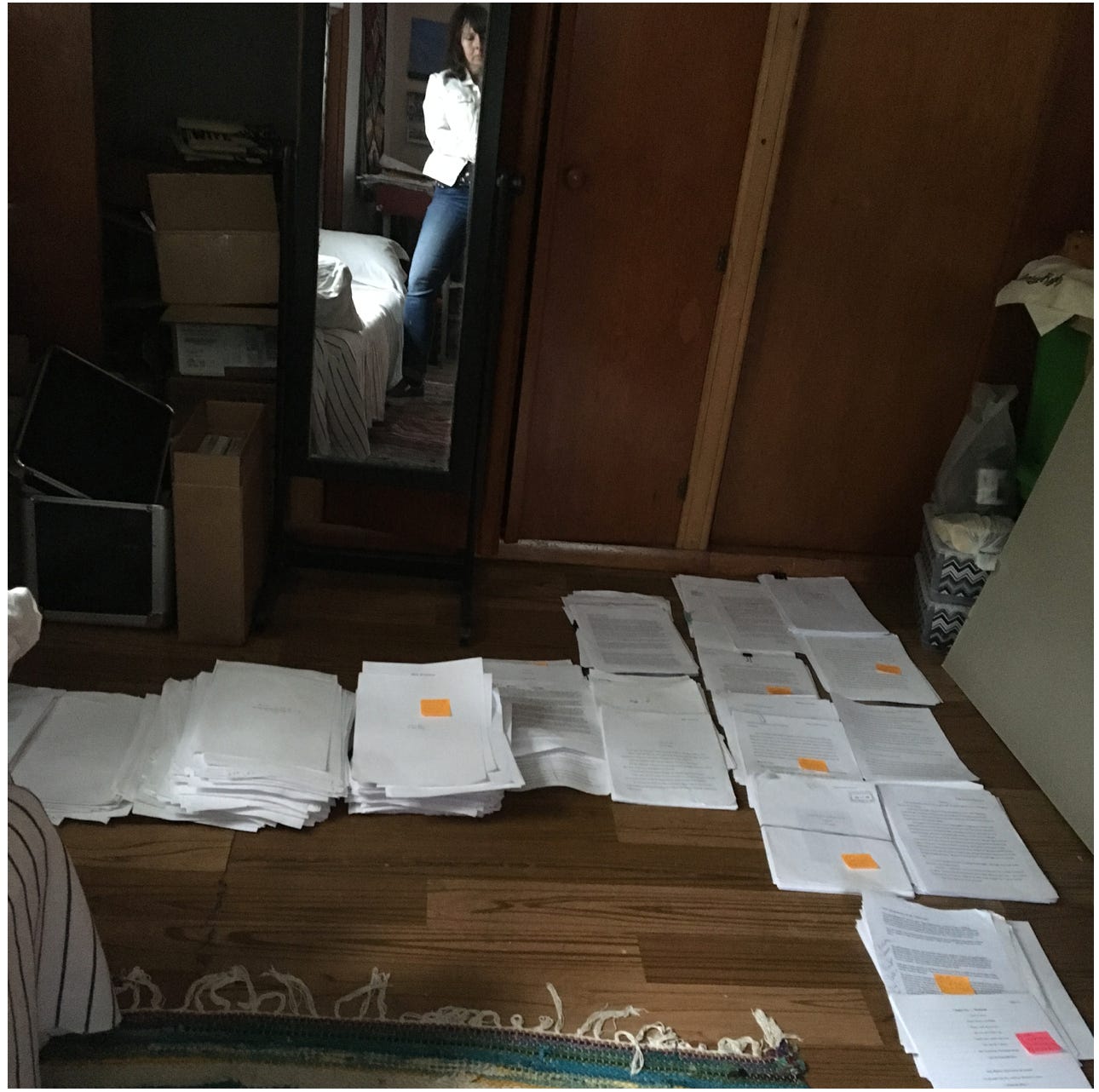
Then I moved everything out of Scrivener into a Word document again. Switched back to my original courier font and kept working. Courier feels friendly, low-stakes. Times New Roman is when you’re ready for the big show.
Eric’s mother declined and died. My Gibson was crushed on a flight from Minneapolis to Winnipeg. Delta paid for me to get it repaired.
In early 2019 I went to Zihuatanejo in Mexico to play at their guitar festival. I carried my laptop with me, hoping for a minute to look at my draft, but was too busy enjoying Mexico. Joyce Maynard had invited me to stop off in Guatemala on my way home, and I spent a week at one of her memoir workshops. I really started to see the end in sight here. It gave me confidence to share small parts of my book with the group of women I spent a week hanging out with. I think it’s not a bad idea to take part in writing workshops or retreats, if you’re selective about it. It can help to have other writers who are going through a similar process cheer you on, and listening to their work gets you out of your head and story, and also fires you up to get back into it. I feel that way when I go see other musicians play who are good—I can’t wait to get back home and pick up my guitar or write a song.
I finally figured out the title, Girl To City, after the famous Daily News headline Ford to City: Drop Dead. Like band names, it takes a lot of effort or no effort at all to come up with a title that feels right. I had the cover photo, taken by one of my Parsons roommates Julia Gorton, who’s a fabulous graphic designer as well as brilliant photographer. I sent her the title and she found the Daily News font to create the cover graphic. I posted the cover on social media before I’d finished the book. It felt like a commitment to get it done.
I arranged to work with a copy editor who’d been recommended to me, but then worried about the process. I asked if she could do just a short sample edit so I could see how it worked and she didn’t feel right about that. I found a different copy editor in the UK who specialized in music-related books and he did a good job and turned things around quickly. The writing was pretty tight at that point but one of my favorite notes of his on what must’ve been one of my trying-too-hard lines— “Save yourself!” he wrote—and that tells a little how that process can work- you’re dressed and ready for a performance and you hope for the friend you’re actually paying to say “um, take off that ridiculous tiara” or “purple is not your color dear.” It’s a weird kind of instinctive thing, for me anyway.
I signed up for Adobe InDesign to do the layout myself and watched tutorial after tutorial, I’m sure like with Scrivener I’ve barely touched the surface of all the program’s features. Julia Gorton helped me so much getting the photos for inside the book in the right file size. The layout was a bitch. The weeks it took to lay the book out felt like they would kill me - I think I would happily farm out the layout work next time if I found the right person. Converting to a flowable ebook was also not easy. The uploading to the Ingram and Amazon sites made my head spin and I screwed up many aspects of both. Again, I would pay someone to do the mechanics next time, even though doing it myself meant at least I was happy with how everything looked.
I made a book trailer in iMovie. My skills were pretty minimal then (I’ve gotten better with the invention of CapCut, but now just find myself always short on time). Learning a lot of new skills was a big part of the self-publishing process. I booked a tour of book-related gigs in the US through October and November of 2019. Those helped me get some reviews for the book, and Terry Gross even had me back on Fresh Air for a second time (the first was in 1997, for Diary). It feels like we were living in a whole different world back then. I wanted to do an audiobook but ran out of time to set that up, so instead made a podcast version of Girl To City, each chapter an episode, and that was a pleasure and gave me a weekly job when everything shut down in March 2020.
Everything is so different now. There was no Substack in 2019. There were still weekly papers in most US cities and more places to get reviews. I kept the self-published aspect of my book pretty quiet, as it still felt like some kind of failure. But people loved Girl To City and the book sold. When I wrote up a proposal for my second book, to see whether I could find a publisher for that one, I added up the sales and saw that I’d made money—was still making money. I decided to spend my time writing rather than hoping for a deal and publish the second book myself.
So this morning I woke up to the sound of peacocks screaming in the car park of a Premier Inn just outside the city of Hull in the northeast of England. I did my first book event last night in a week of UK shows. I’m very tired and wonder half the time what I’m doing and why I push myself to get yet another book into people’s hands. As my dad said, when I told him I was writing the first one: “What, music’s not hard enough—now you want to write a book?”
It’s connection. “Only connect,” said E.M. Forster. I just wanted to read a little of my story in Hull which is an important place to me (ya have to read the book to find out why). Sing a few songs, read some stories and see if any of it landed. I want to share it in Scotland and other spots in England and wherever they’ll have me. I’m the guy in the mud on the football field—he’s not the biggest or strongest, but he believes in the power of words and music. He cares enough about the small everyday moments of people’s lives to keep picking himself up and trying to give them something to cheer for or nod along to. It’s just words and paper (or okay, an illuminated screen) or notes to sing over chords to play and it’s so basic but it’s what we’ve got.
So, if you’re looking for mechanics of self-publishing, there are many many sites out there. As with life, I bumble my way through. But if you feel like you belong in the world of books, you do. And if you have a story to share, it matters to someone. Since we’re in sports/war movie territory, I’ll trot out a phrase from the unlikely NY Mets via Tim McGraw’s dad, pitcher Tug McGraw: “You Gotta Believe!” It’s basic but it works.
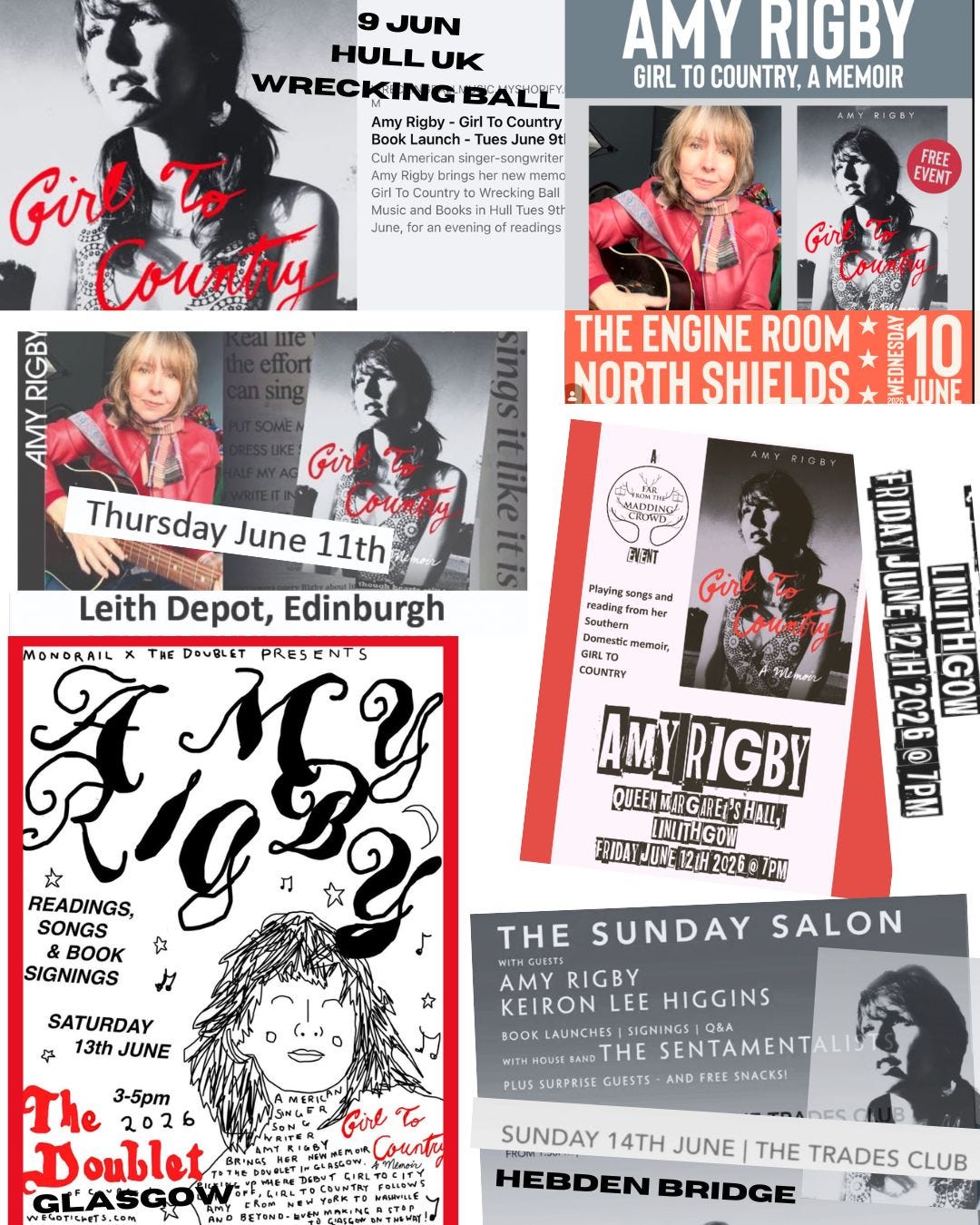
Out playing these book-related gigs this week, with some US ones coming in late Oct/early November and more in the UK late 26/early 2027. Look for Girl To City and Girl To Country via your local bookstore or wherever you buy your books, I’d put it a bunch of links to purchase but I need to drive to Edinburgh now!
I love hearing that you are talking about the book and doing readings to an audience who loves your music now. It just seems smart because you have an audience other writers don’t. You have done the heavy lifting of making the books. Time to sell the story with the voice in performance. You by-passed the gate keeping!
Learning stuff, as usual! ("Courier feels friendly, low-stakes. Times New Roman is when you’re ready for the big show")