

"You Have Just Recorded..."
A studio clip show

“Gentlemen (and lady), you have just recorded your first number one.”
I don’t think it’s just me. I feel sure any musician who began making records in the twentieth century, and perhaps continues to this day, has that moment at the end of a take where you’ve strummed the final chord and are holding completely still while letting it ring out, taking its good sweet time across a luxurious amount of an imagined reel of tape, and the producer’s voice from a control room complete with leather sofa comes through your headphones to pierce your concentration with the good news: you’ve created a hit. It’s not even a surprise. You’ve known it was a hit since the moment the first line came to you and others followed over the space of two minutes and fifty eight seconds, and you felt it deep in your heart and soul—this! This is the one! The one that changes everything…
Okay, maybe it is just me?
The reality is different: the studio is tucked away in a house, a neighbor wheels a recycling bin past the window; a basket of laundry sits in the hallway outside the door. No matter—I’m making a record and it’s varying degrees of hope, delusion, hard work, and magic.
I’ve tried hard to be regular with my Substack posts — every two weeks is my aim—BUT sometimes other work takes precedence and in this case, it’s making a record. So, I’m sorry this post is a week behind (though sometimes I feel like I’m drowning in reading all the Substacks I follow and can’t handle the volume, so maybe I’m doing you a favour by lightening your reading load?)
Eric has worked hard to set up his studio in our place in Norfolk. Removing a woodburner, doing some soundproofing, swapping out a genteel net-curtained window facing the neighbor’s house several feet away with a piece of large obscure glass. Our friend Rick the builder, who sadly passed away last month and we are still reeling from that, helped him shift the door to open the other way (doors take up a lot of space). Eric has done a lot of recording in there since we moved less than two years ago: England Screaming, his brilliant re-recording of an early 80s album; various tracks of his own (we did do a Christmas song the first winter, Festive AF). This fabulous duo Lassie came in over the spring to make a record, the first single White Hair is out now. They’re wonderful singers and players with imaginative, memorable songs, and are helping make up Eric’s current band that also includes me (next gig at Boogaloo Highgate London Sun 26 July 2 PM).
Generally I’ve been cowering upstairs in my office since we moved here. Writing, finishing Girl To Country; making my own demos, recording the podcast version of the book. Even writing a song or two. I think I’ve been afraid to start making an actual album in the new studio because…it’s new. It’s not where I made the last couple albums. The unknown.
It’s got me thinking about all the recording over all the years. A good thing about writing memoir is I now have a memory bank over two books (and years of blog posts but those I just kind of crank out whereas with book writing I work hard to cast myself back into the moments I’m writing about, like a screenwriter in reverse) where I can dredge up scenes with very little effort. Maybe that’s kind of sad, to think that once you’ve committed moments to “literature”, there won’t be much point to revisiting, but I suppose you can always find new lenses to look through.
I think what finally got me started on this post, as I find it hard to write about work as it’s happening—feels like it might jinx it or take away from the process, to try and set down the nuts and bolts, like a magician revealing the mechanics of their tricks—I posted a photo on Instagram the day we started recording and Lenny Kaye commented, sharing a David Lynch quote, that the pleasure was in the doing. It reminded me of recording with Lenny, back in Shams days. He was such an encouraging presence in the studio. It made me want to share a few recording scenes—not to turn this post into a “So It’s Come To This: A Simpsons Clip Show”, the dreaded device for filling the void! Well, maybe I am, hey what is wrong with an occasional clip show?
So here are some recording scenes, from Girl To City , Girl To Country and the blog:
1980
Gina lived across Monmouth Road in a more grown-up version of her old room—she had a bedroom, sitting room, kitchen and bath. Palmolive from The Slits’ sister Esperanza and her husband Richard Dudanski of the 101’ers lived in the squat on the other side of the tiny street. I felt like I was living in an issue of the New Musical Express, the British music journal Bob and I had pored over back at the dorm. I was a little breathless around all of the music people I knew, especially Gina, never forgetting the impression she’d made on me at Tier 3, with her long dark blond hair shining, huge bass slung low while she swayed and shouted, with an alternately tormented and blissful look on her charming face. But she was kind, and invited me for tea or a curry, and to Berry Street studio in East London, where the Raincoats were recording their second album. I’d never been in a studio before and it was tense and technical and thrilling.
The studio felt very different from the controlled chaos I’d experienced at live gigs. I didn’t want to get in the way, so I sat very quietly as the band did multiple takes of a song. I wondered how they knew when they’d finally gotten it right.
1982
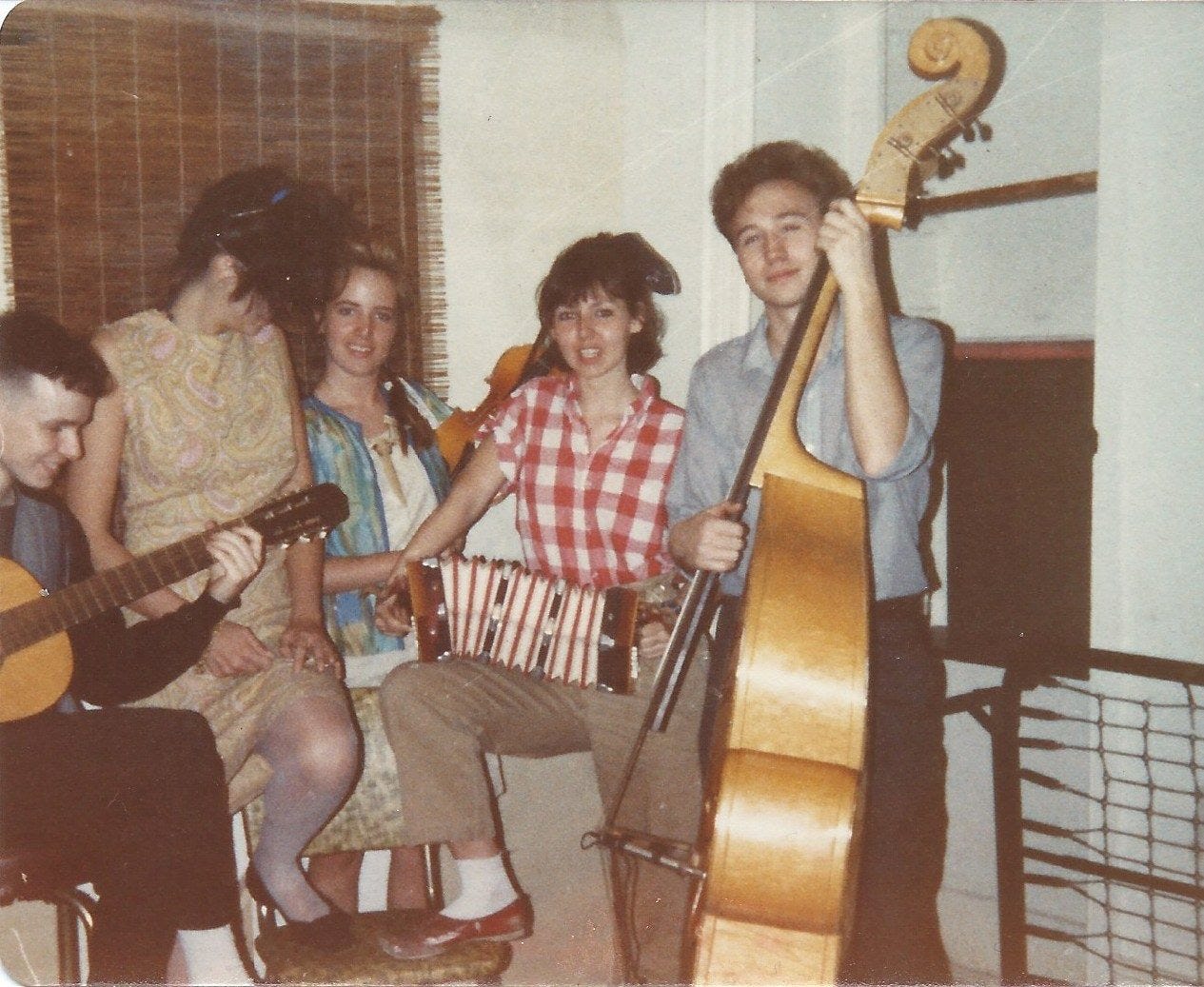
Don Christensen, the Raybeats drummer and Dan Dryden, a childhood buddy of his from Nebraska who worked as a sound engineer with Philip Glass, offered to record the first Last Roundup line-up in their studio which shared a loft with Don’s living space down on Warren Street. The six-song recording (“Let’s Get Lost,” “Bargain Bin,” “Borderline,” “Blackfoot,” “Ice Tea” and “Atlanta”) was never circulated beyond the band members playing the tapes for ourselves like monkeys who’ve discovered fire: “It’s us! On tape!”
Listening now, it’s an eerie artifact, an aural diorama of early eighties East Village settlers clothed in reverb, thrift shop garb and tape hiss. Don and Dan corralled us all around one microphone, trying to capture the oddness before we became even mildly proficient at anything. They’d seen the value in that moment of discovery, but all we wanted was to get closer to something resembling proficiency.
1984
We recorded a new demo on the 4-track Tascam Portastudio, which my brother John had sent as a gift from his travels on a US Navy aircraft carrier. Michael hung a microphone over the shower curtain rail in his bathroom to add reverb to the vocals.
1985
Cowboy Jack’s place was intimidating for a young group. Johnny Cash and Waylon Jennings had recorded there. The Cowboy himself, renaissance man producer/writer/legend, puttered around on the ground floor in his office or the kitchen and out in the backyard. To get to the studio you climbed a cloud-painted staircase to the second floor, where the control room was tucked away on one end, with no window looking over the room where recording took place. I hadn’t been in enough studios at the time to know how unusual that was. The whole set-up was meant to be relaxed, low-key and casual. It worked for Johnny or Waylon. What if one of them stopped by to see Cowboy Jack while we were working? We were all thrilled and terrified at the thought.
There were no headphones allowed in the Cowboy Arms. The idea was to play and sing like we did in our rehearsal room or on stage. There were to be no overdubs. Everything was going down live: upright bass, acoustic guitar, washboard, electric or lap steel guitar. And vocals.
Jim Rooney was the producer Jack and Andy had chosen. He had lots of experience with bluegrass and folk musicians, where technical prowess was almost a given. He didn’t know what he was getting into.
“Makin’ magic here—makin’ history, darlin’!” Jack Emerson shouted regularly from the control booth. He knew we had style, and songs, and a singer. We’d played dozens of shows and were a tight outfit. But the exhortations to “make magic” had the opposite effect.
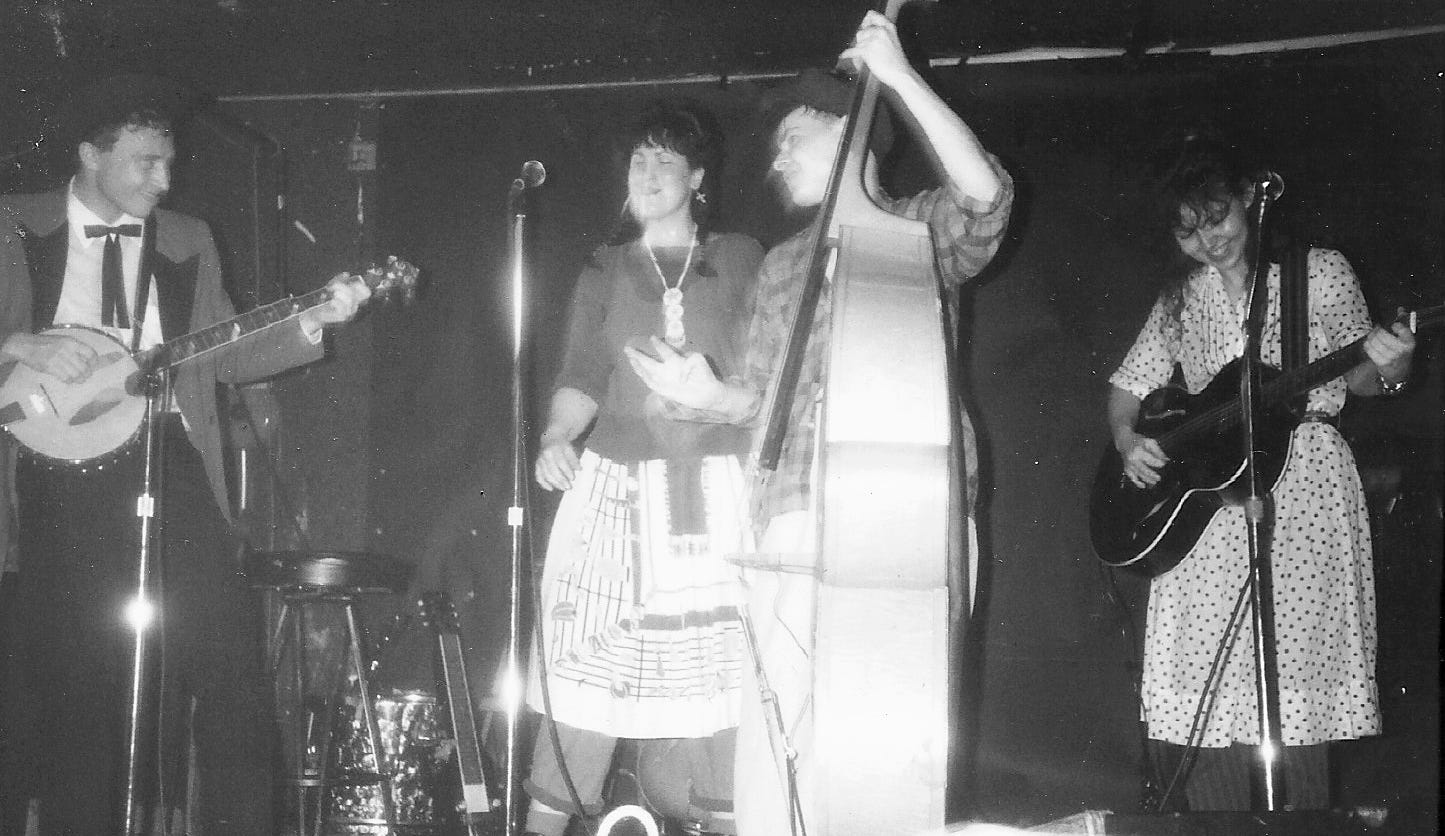
Some takes, we’d pump ourselves up to where we’d almost be having fun: Michael would unleash a yell perfected at Penguin hockey games and heave the cowbell around; Angel hooted like an owl; Garth let out a manly growl and thumped the bass; I did soulful strumming, pogoing crossed with clog dancing or heavy metal head banging.
But there was take after take and the hijinks started to fade away, leaving us to face that we were good on the Pyramid stage, playing for drag queens and oddball East Villagers. Some nights—at Folk City or in Michael’s apartment with no one there but the four of us—some nights, we were magnificent. But in Music City, among professional engineers and producers who did this for a living, we felt like amateurs. Not imposters, never that. We believed too much in what we were doing to fake it. If we weren’t as good as back in the days when we were charmingly bad, we hadn’t yet reached the point where we were truly good.
1987
Unlike in Nashville where the pressure had been on to capture the entire performance in a take, all we had to focus on was tempo and dynamics. We’d played the songs so many times, the changes were ingrained. The role of every instrument was tied to the others: hear that woodblock, start strumming. Lock in with the bass as soon as he finishes that three note descent. It was simple music.
My guitar parts weren’t difficult. As long as the chord changes sounded clean, the strings didn’t buzz, and I could take it easy and not bang into the microphone aimed at the f-holes on my big black Gibson archtop, there was nothing to worry about. Overdubbing acoustic guitar meant capo’ing the guitar to play the chords in different positions, making the sound bigger and fuller. There were even little studio tricks, like when Lou slowed the cording speed of the tape down slightly to play on top of with the effect of spreading the pitch wider. We weren’t aiming to change the arrangements from what we could achieve live, just to beef things up a little. For the first time, I realized that I loved recording. It had previously been just a means to an end—a way to get gigs, or entice a record label—but now I was seeing it as a whole other realm of creativity. Those little things that happened in the room, now, that couldn’t be orchestrated, were where the magic was. The moments where the feeling came up through your hands and throat and straight into the microphone, so whatever you were feeling, a listener could feel it too. Those were the moments that kept me coming back to the records I loved. Not perfection, but glorious imperfection, the catch in Gram Parsons voice or that point in a Louvin Brothers harmony where they barely pulled themselves back from the brink of losing control.
1992
The Shams looked nothing like a band when we arrived at the studio straight from our day jobs. Sue would be in paint-splattered jeans and pajama shirt, her hair flecked with whatever decorative paint color Marlo Thomas’ or Bill Murray’s apartment renovation required that day. Amanda would be dressed in one of the latest creations from her clothing line Living Doll. I’d be in my secretary skirt and sensible shoes from riding the subway to my midtown office job. A sort of East Village People, it was around the studio microphone that we became a gang.
We recorded basic tracks first, with Sue on bass, me and Lenny playing guitar and Will drumming on some of the tracks. Unlike our single and a lot of our demos, made on a Tascam four-track, we had sixteen whole tracks to work with. It felt luxurious but there were practicalities to consider. When Will came to the studio, Hazel had to come too, and she’d arrange her Simpsons and Animaniacs and Little Pony figures on the carpeted dais behind the mixing desk until she fell asleep face down on the floor. Was her ability to fall asleep anywhere a gift or a skill born of necessity?
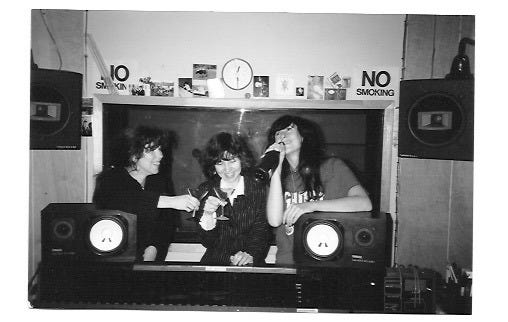
Most of our time in the studio was spent recording vocals. We tried it all different ways: the three of us around one microphone, or each of us on individual mics at the same time. There may have been a song or two where we recorded separately, one at a time, but achieving a performance, even if it was cobbled together from a few different takes, worked best when it was the three of us, like a synchronized swimming team or rowers in a scull pulling together down a river. Not that we were ever about discipline and precision. The Shams were a ragtag team aiming for the heights, and Lenny was a patient coach encouraging us at the very least to reach for honesty and sometimes the sublime. “Imagine air blowing through a hot metal pipe up your ass,” he said. Not poetry but it freed up something!
1993
November of 1993 I went into Pie Studio on Long Island with Gene Holder producing. We recorded twelve basic tracks in two days. I played the green Greco and sang scratch vocals, and we planned to do overdubs and vocals later at Water Music in Hoboken. The initial weekend was a whirlwind of focused concentration, almost like playing live. We’d run through each song a time or two and stick to the arrangements we’d used on stage, or rough things out on the spot.
The overdubbing at Water Music was fraught with technical difficulties: channels that didn’t work, headphones that went dead. But the studio was giving us a cheap rate so it allowed us extra time to work on vocals. I was self-conscious about having my voice exposed, with no other singers to blend into. Sue came in to sing some harmonies: this bit of camaraderie in the vocal booth was a good distraction. Standing alone in front of the microphone can feel like communion or pressure, or both. You want to give your best, without sounding like you’re trying too hard.
1996
We moved on to continue the recording at Mark Linett’s in Glendale. Your Place Or Mine was a basement studio L.A. style, with graceful swimming pool and lush landscaping outside, a trio of Scottish terriers straight off a forties holiday card and the original recording console from Western Studios. He had recently mixed Pet Sounds in stereo for the first time, sitting right in this spot with Brian Wilson. I hoped the molecules in the air held onto some of Brian’s genius.
Mark was quiet in the way of some great engineers, his sly sense of humor a perfect foil for Elliot’s. They had a competitive relationship that reminded me of brothers, and made me feel at home.
1998
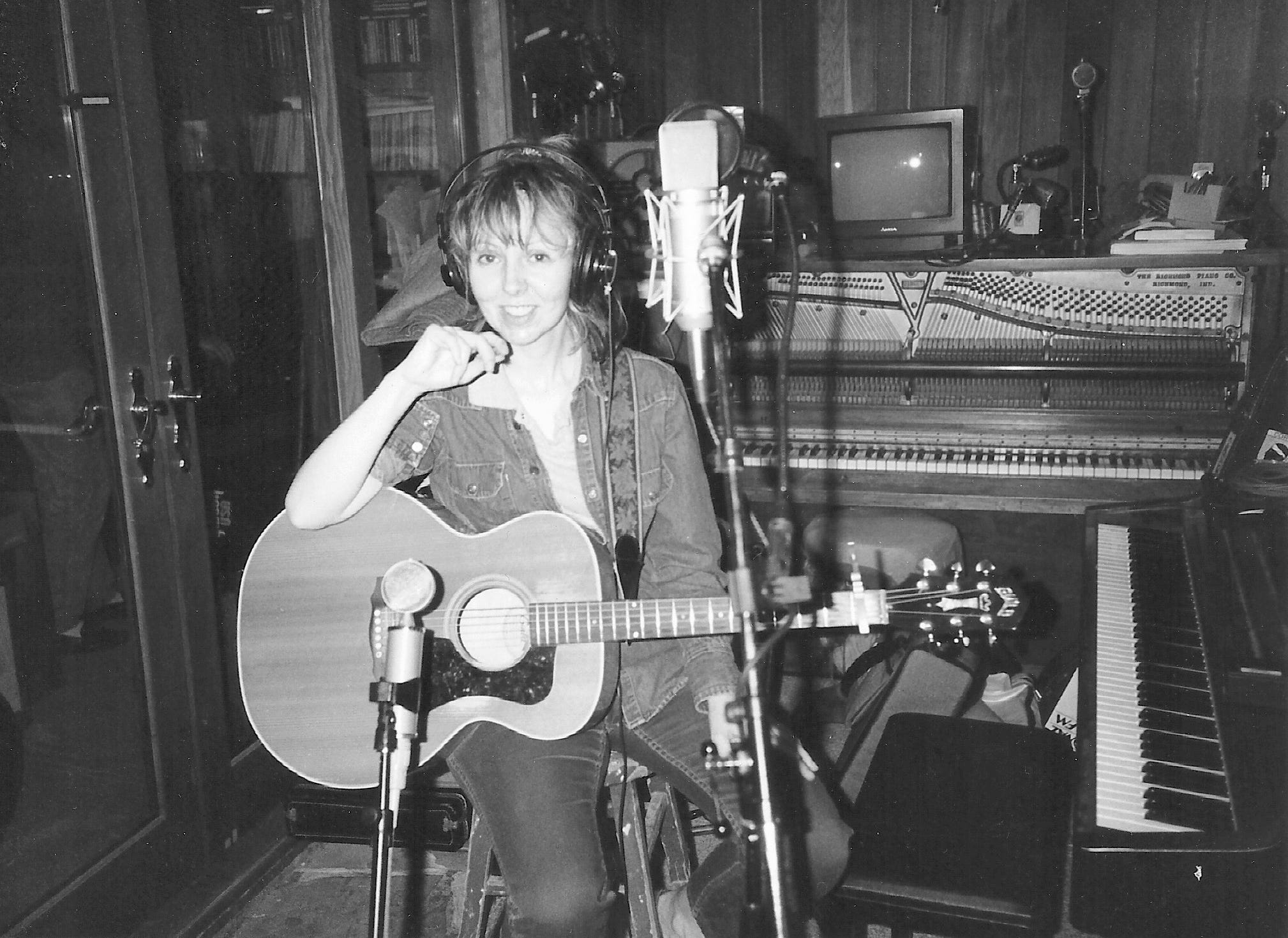
I’d spent enough time in L.A. to decide I didn’t have the ego or confidence to live there; it was simultaneously too sprawling and too insular. The thought of finding a place to live and a school for Hazel, while trying to book gigs and navigate the industry side of town, intimidated me. But I returned there in the spring of 1998 to record my second solo album. Elliot Easton and I chose a dozen songs and worked at Mark Linett’s studio in Glendale, where we’d pulled together all the tracks for Mod Housewife two years before. Elliot played bass and overdubbed guitars. I played guitar; Don Heffington was back on drums and percussion, and keyboard player Tom Canning joined us on a number of songs. Recording the basic tracks was alternately blissful and hilarious— the songs came to life with Elliot full of ideas and everyone else bouncing suggestions. Nothing felt too wacky.
Some of the vocals slipped out easily: “Summer Of My Wasted Youth” and “Invisible.” But recording the harder-edged songs was torment. I wanted to be a rock vocalist—felt like a strutting rock belter in my soul—but when I stood at the microphone, all that came out were my feelings. They weren’t elevated or made majestic by lung power or bravado and technique. Try as I may, I was usually just…a person, singing my songs.
fast forward to
2024
…Eric and I were really pushing to stack up enough tracks so I could have a complete album finished before we dismantled our lives and the studio to make an overseas move. The pressure was on. I came up with a swampy guitar figure to approximate an early demo version I’d lost when my hard drive crashed, and Eric put in some brutal fuzz bass. I’d tried doing a low harmony all the way through the earlier version that had worked on the demo but sounded a little atonal over a more rocking track. Some vocals you have to work and some are better not labored over and this was one of those —don’t try to sell the song, let the words and music do the talking. Eric is a great vocal coach in the studio : “You need to be there, but resist the urge to join in,” is one of his koans that usually does the trick for me.
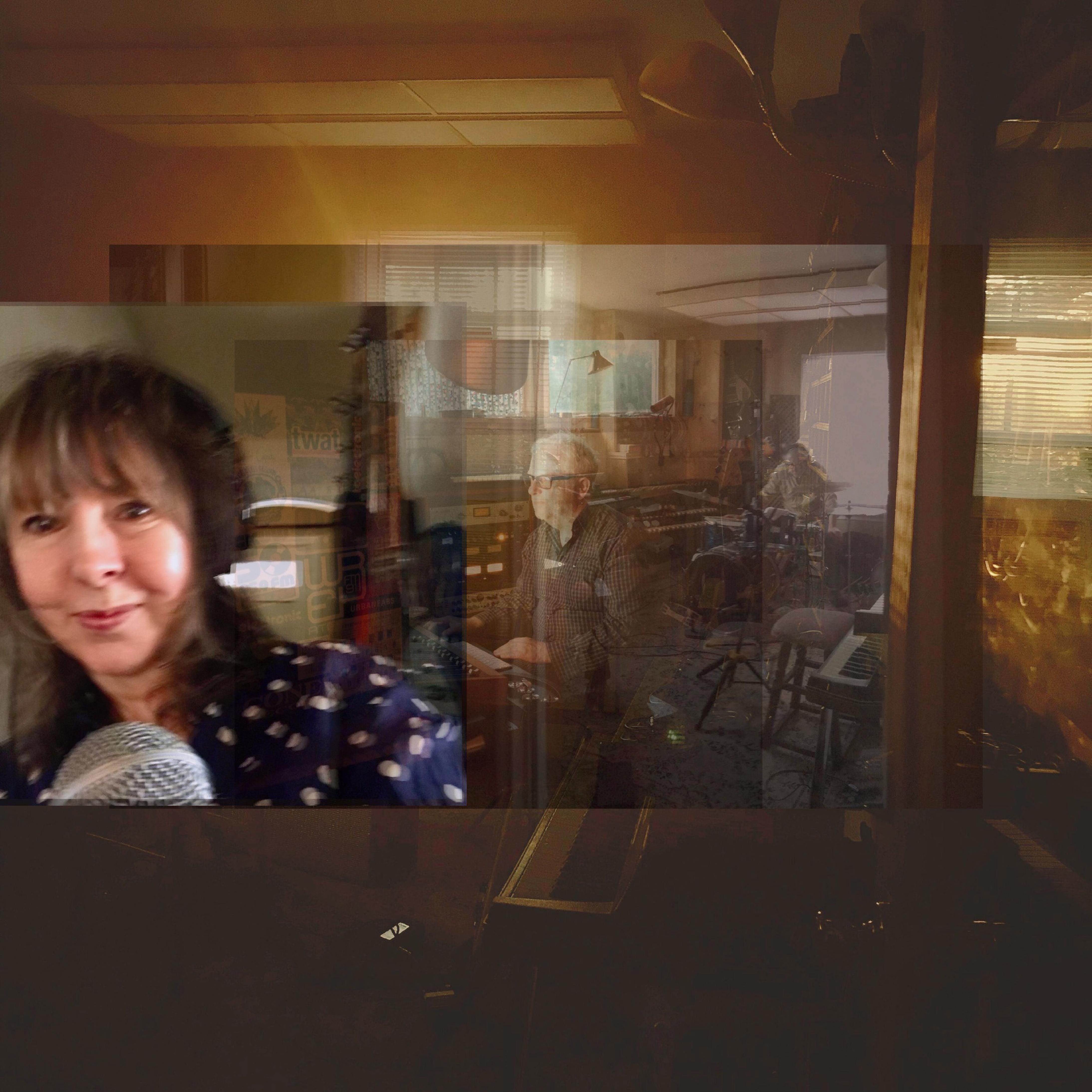
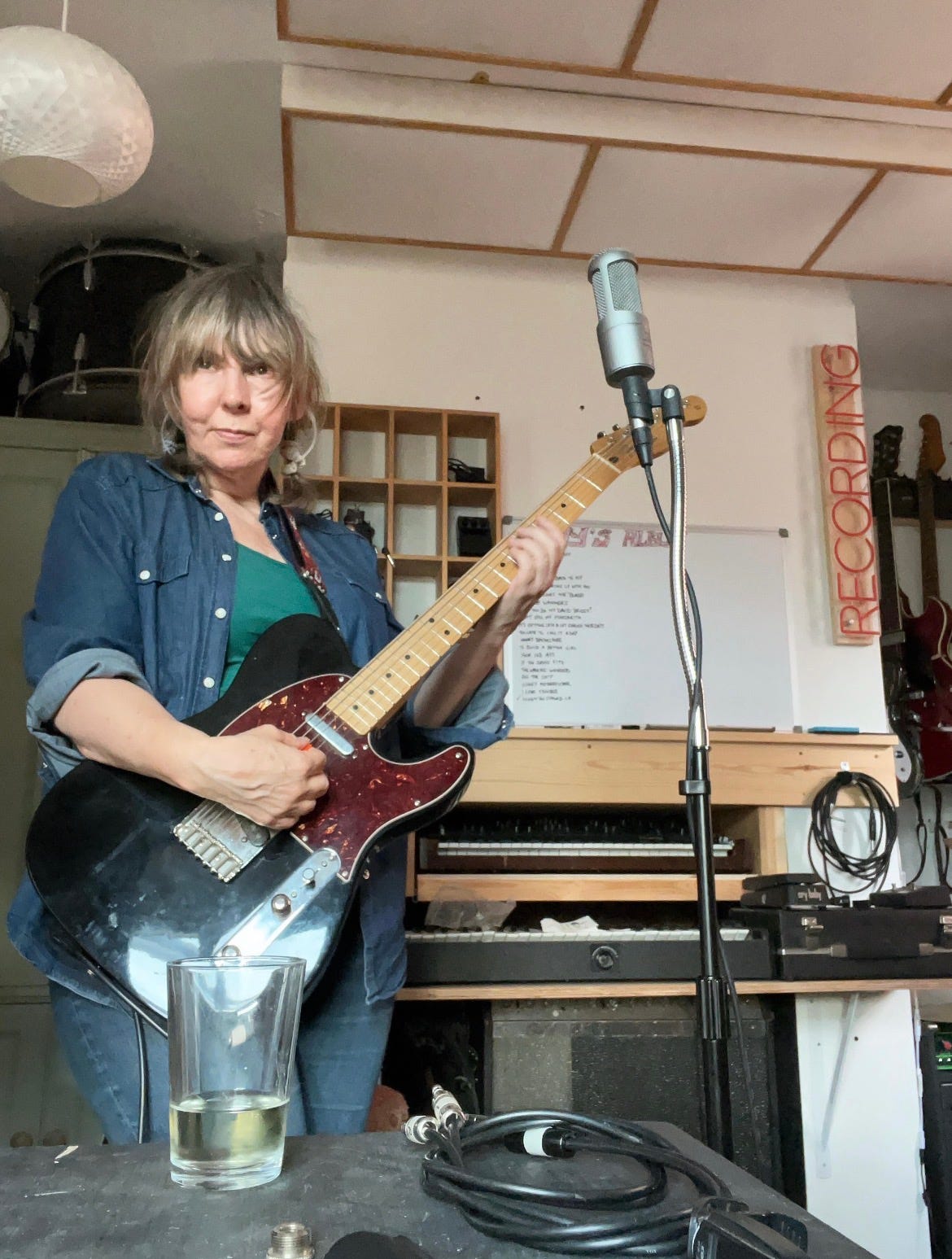
So gathering all this together (and I could go on and on sharing scenes from the books and the blogs over what now spans…umm let’s see 1982 to 2026, good lord I got out my calculator and that’s forty four years ), looking at the photos makes it seem like a lot of fun. And it for sure is. There are also plenty of tears of frustration, moments of futility, songs and tracks dumped that don’t work; heights reached for that aren’t achieved. But I mostly feel lucky to continue doing this impossible thing —again. Thanks to all who’ve sailed with me (many gone too early: Jack Emerson, Lou Whitney, Jim Wunderle: Don Heffington) and to Eric who works so hard and reminding me: “If you don’t do it, it won’t get done.” I see many of my fellow musicians asking “Is there any point to making albums any more?” Maybe we are like those Japanese soldiers who carried on fighting in the jungles after World War II ended. I know it’s a common analogy people use to describe persevering beyond the point of reason. Usually it’s attributed to “they didn’t know the war had ended.” Some soldiers feared they’d be punished for giving up. I like to think we’re the third variety—carrying on out of a sense of honor. Also because it’s fucking fun. Here’s to work being the destination. Here’s to still living in hope.
Meanwhile, got gigs on the horizon! info here and more to come…
Sun 26 July London UK Boogaloo Gospel Brunch (Wreckless Eric gig, w/ Lassie)
Sun 30 Aug Rugby UK Dean Friedman’s SongFest!
Sat 5 Sept Norwich UK American Library
Fri 11 Sept Cromer UK Grey Seal Coffee
Thu Oct 22 Norfolk VA Vessel Craft Coffee
Fri Oct 23 Raleigh NC Mitch Cantor’s house concert
Sat Oct 24 Atlanta GA Criminal Records instore 4 PM
Sun Oct 25 Water Valley MS Tim & Susan Lee’s house concert
Tue Oct 27 Memphis TN Listening Lab presented by Burke’s Books
Thu-Sun Oct 29 - Nov 1 Lake Leelanau MI Lamb’s Songwriting Retreat
Thu Nov 5 Columbus OH Natalies
Fri Nov 13 Hoboken Little City Books tbc
Sun Nov 15 Brick NJ Rosie’s Cafe house concert
Wow, I remember meeting Don and Dan when I was doing a job for Phillip Glass, maybe '83? I was setting up gear for him and Kurt M. I came over and did some fixing up and building for Maddy Prior up north (not far from Carlisle). Now I offer my services as a guitar/lap steel player. Fewer injuries, but lots more money! hahaha. Be well.
When you wrote, "I see many of my fellow musicians asking 'Is there any point to making albums any more?'" I thought, if you don't do it, who will?